Bayesian Networks Guide Layered Resource Allocation in Mixed-Variance Casino Portfolios
Taylor Richter · Aug 22, 2026
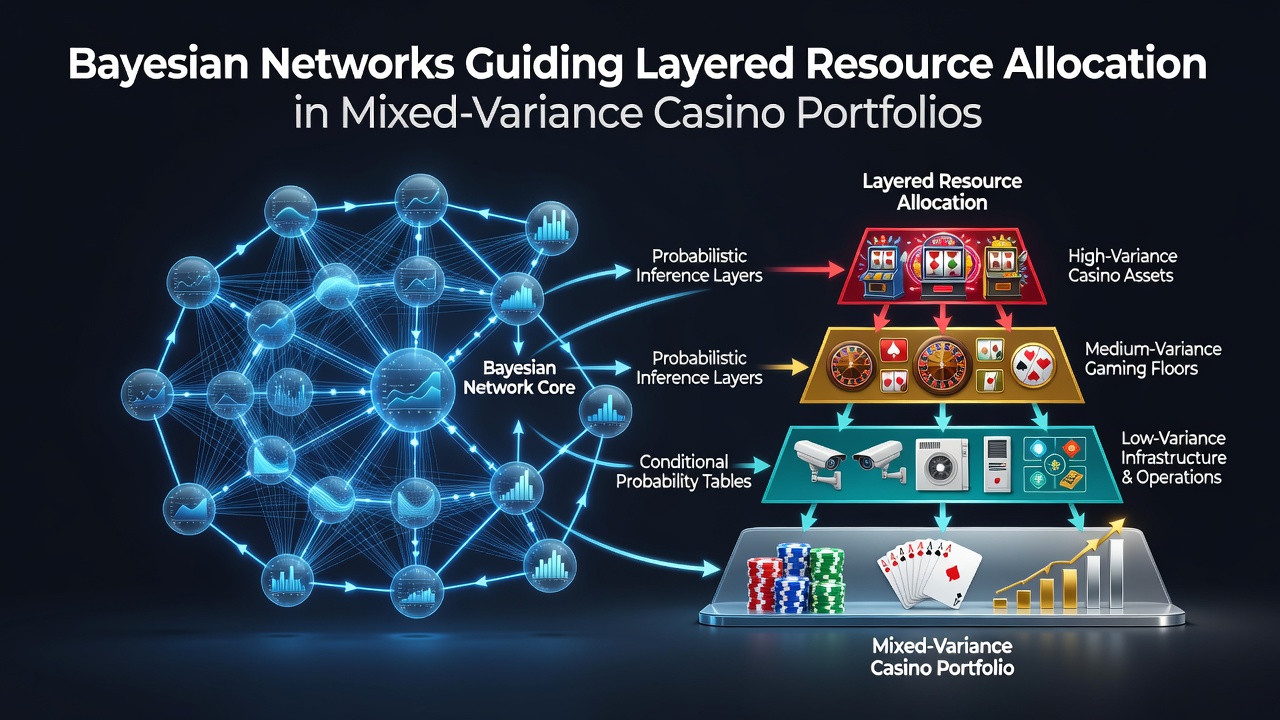
Bayesian Networks Guide Layered Resource Allocation in Mixed-Variance Casino Portfolios
Bayesian networks model probabilistic relationships among variables in casino operations, and they direct how managers distribute capital, staffing, and promotional resources across portfolios that mix high-variance table games with low-variance slot banks. These directed acyclic graphs encode conditional dependencies so that updates to one node, such as a shift in player traffic, propagate through the network to adjust allocations at multiple layers. Data from integrated casino management systems feed the models continuously, which allows the networks to recalculate expected values and risk measures each time new observations arrive.
Core Structure of the Networks in Casino Settings
Each network contains nodes for game type, player segment, time-of-day demand, and historical variance metrics, while edges represent conditional probabilities learned from transaction logs. High-variance nodes capture outcomes from games like roulette and certain progressive slots, whereas low-variance nodes track steady performers such as video poker and electronic blackjack. Layered allocation then occurs when the model outputs separate recommendations for strategic reserves, tactical floor adjustments, and operational staffing levels. Researchers at several North American institutions have documented how these layered outputs reduce idle table hours while maintaining required service levels during peak periods.
Implementation Patterns Observed Through Mid-2026
By August 2026 multiple regional operators in the United States and Canada had deployed pilot versions that integrate Bayesian networks with existing revenue management platforms. The networks ingest daily drop figures, hold percentages, and comp redemption rates, then produce allocation vectors that assign marketing budgets to player cohorts according to their contribution to portfolio variance. One documented case involved a mid-sized property that reallocated dealer shifts away from low-traffic high-variance pits after the model flagged an elevated probability of negative daily variance exceeding internal thresholds. Similar deployments appear in Australian casino groups where regulatory reporting now includes model-driven resource plans submitted to state gaming authorities.

Training data typically spans three to five years of granular transaction records, and cross-validation ensures the networks generalize across seasonal patterns and special events. External factors such as local sports calendars or tourism indicators enter as additional parent nodes whose probabilities update in real time through API feeds. The resulting posterior distributions guide decisions at each layer: capital reserves protect against tail-risk scenarios identified in high-variance branches, while floor staffing algorithms balance labor costs against expected table utilization derived from low-variance branches.
Integration With Existing Regulatory and Data Standards
Operators coordinate these models with reporting requirements set by the Nevada Gaming Control Board and the Alcohol and Gaming Commission of Ontario, which both accept quantitative risk assessments derived from probabilistic frameworks. The networks produce auditable trails because every allocation recommendation traces back through the graph to the specific evidence nodes that triggered the update. Industry reports from the Canadian Gaming Association note that properties using such systems have submitted variance forecasts that align closely with realized outcomes over multi-month test windows. Academic papers hosted by university repositories further detail sensitivity analyses that test how changes in prior distributions affect downstream resource layers.
Training cycles occur weekly, and incremental learning algorithms allow the networks to incorporate new game introductions without full retraining. When a new high-variance title launches, its node receives an initial prior based on comparable titles, then updates rapidly once live data arrives. This approach keeps allocation layers responsive while preserving stability in the lower-variance segments that anchor overall portfolio performance.
Conclusion
Bayesian networks supply a structured method for propagating uncertainty across casino portfolios that combine games with differing variance profiles, and they translate those probabilities into layered resource decisions that operators can implement and regulators can review. Continued data integration from multiple jurisdictions supports refinement of the conditional probability tables, which in turn sharpens the precision of allocation outputs at each layer.