Exploring Computational Strategies for Hand Selection Across Diverse Payout Models in Hold'em Events
Taylor Richter · Aug 15, 2026

Exploring Computational Strategies for Hand Selection Across Diverse Payout Models in Hold'em Events
Texas Hold'em tournaments rely on hand selection algorithms that adjust starting ranges based on stack sizes, position, and the specific payout structure in play, and these adjustments become particularly noticeable when events reach later stages where pay jumps grow steeper. Researchers have documented how programs such as those developed at the University of Alberta's Computer Poker Research Group integrate Independent Chip Model calculations to shift recommended ranges, and data from major circuits shows these shifts occurring consistently across both flat and progressive payout formats. Observers note that early in events the algorithms favor wider ranges because survival pressure remains low, whereas near the money bubble the same systems tighten dramatically to preserve chips that carry higher relative value.
Core Mechanics of Hand Selection Algorithms
Hand selection algorithms process thousands of possible starting combinations against simulated opponent ranges and then output equity estimates that account for future betting streets, and they incorporate payout multipliers by converting chip stacks into expected monetary value at each stage of the tournament. Studies indicate that when a structure pays the top ten percent of the field with steep increments after the final table, the algorithms reduce opening frequencies from early position by as much as fifteen percent compared with flatter payout schedules. Those who have examined large databases of online and live events find that players who follow algorithmic recommendations experience measurable differences in survival rates once they enter the paid positions, especially when the remaining field size drops below thirty players.
Payout Structures and Their Influence on Decision Points
Tournament organizers publish payout tables that range from highly top-heavy models common in televised final tables to more even distributions used in many daily online events, and each model changes the mathematical weight assigned to every remaining chip. When payouts concentrate heavily in the top three spots, algorithms assign greater value to chips that allow a player to reach those positions rather than to chips that merely secure a min-cash. Figures from events held in August 2026 reveal that fields using progressive structures produced higher average survival times for stacks between fifteen and twenty-five big blinds because the software recommended folding marginal hands that would have been played under flatter schedules. In contrast, events with more even distributions showed algorithms maintaining wider ranges deeper into the day because the marginal value of each chip stayed relatively stable across more finishing positions.
Integration Points Between Algorithms and Payout Models
The intersection becomes clearest at pay jumps and during final table negotiations, where algorithms recalculate ranges after each elimination and feed updated equity figures to players or coaches who rely on real-time software. One documented case involved a European circuit stop where the final nine players used ICM-adjusted ranges that reduced all-in frequency by nearly twenty percent compared with pre-bubble play, and the same software produced different outputs when fed the flatter payout table from a concurrent online series. Data shows that players who override algorithmic suggestions at these critical junctures often experience wider variance in results, while those who adhere see tighter clustering around expected value projections derived from the specific payout matrix.
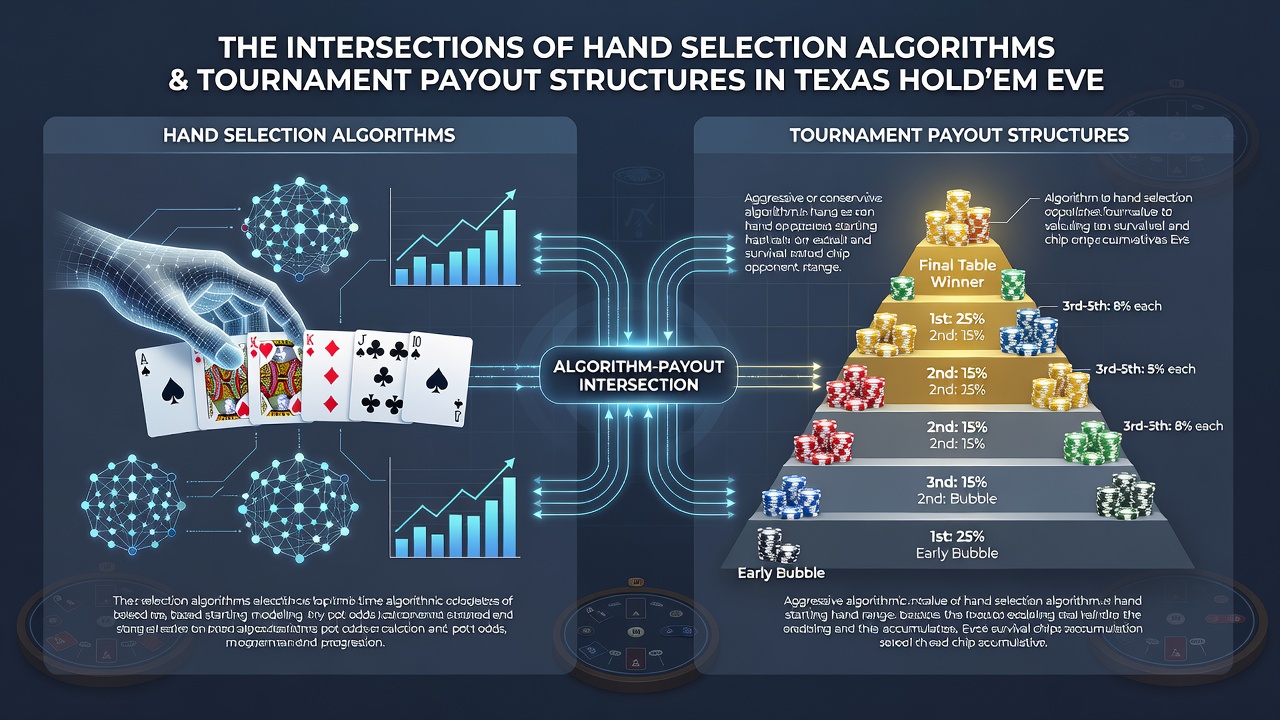
Additional layers appear when algorithms incorporate opponent modeling modules that track historical tendencies at specific stack depths and payout thresholds, and these modules further refine ranges by reducing bluffs against players who have demonstrated high fold frequencies near pay jumps. Research published through academic poker groups demonstrates that such layered models achieve higher accuracy when the payout structure is known in advance rather than when it remains uncertain until late registration closes. Those who have reviewed large sample sets note that the accuracy gap widens further in tournaments that employ multiple starting flights with staggered payout tables, because the software must handle several distinct equity curves simultaneously.
Practical Applications in Modern Events
Coaches and serious players now load payout tables directly into their software before registration opens, allowing the algorithms to generate stage-specific ranges that update automatically as the field shrinks. This practice has become standard in both high-roller events and mid-stakes daily tournaments, and records from August 2026 indicate that fields using such pre-loaded data produced fewer instances of players busting just outside the money with hands the software had flagged as marginal. The same systems also assist in final table deal negotiations by converting current stacks into real-dollar expectations under the remaining payout structure, which in turn influences whether players accept or reject proposed chop figures.
Conclusion
Hand selection algorithms and tournament payout structures interact through continuous recalculations of chip value that affect every decision from the first hand to the final river, and the precision of those calculations has increased with advances in computational poker research. Events scheduled for the remainder of 2026 continue to supply fresh data that refines these models further, particularly as organizers experiment with hybrid payout formats that blend elements of both flat and top-heavy distributions. The resulting frameworks allow participants to align their ranges more closely with the mathematical realities of each specific tournament design.